
Use Case #1: Keyword research
When I'm doing catchphrase research for a customer and I'm gazing intently at a rundown (likely a large number of lines long) of potential watchwords to examine and their hunt volumes, I attempt to irregularity comparative ones together to see examples of closeness. At Distilled (we're procuring, btw!), I may utilize an apparatus like Brightedge or SEMrush to see the questions a site has perceivability for. Moreover, I could simply put a point into Google Keyword Planner and get a yield of comparable terms per Google. Send out your outcomes in a CSV record and you'll have your beginning stage for information investigation. You may significantly think about how the equation I said before could even be valuable since Google Keyword Planner gives an "Advertisement Group" section, so one ought to effectively have the capacity to know how to isolate up the gave catchphrases.
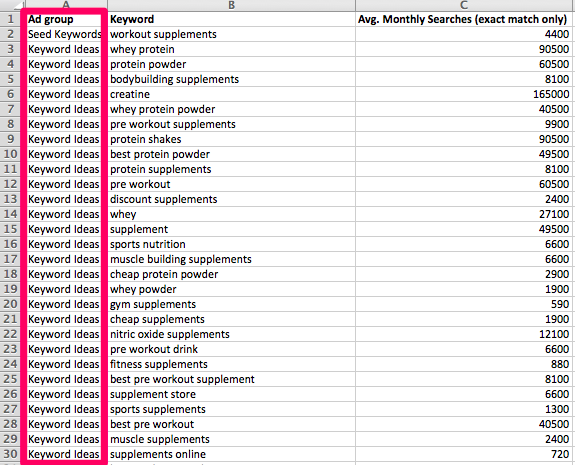
Issue is, the yield is regularly partitioned up between "Seed Keywords" and "Catchphrase Ideas", neither of which is useful for dividing watchword companions. The screenshot above catches the inquiries and quest volumes around related terms for "workout supplements" (take note of the "Seed Keyword" in cell A2 contrasted with all others.)
In any case, consider the possibility that I need to separate this whole rundown (681 questions, clearly all not appeared in the screenshot) to discover what number of inquiries incorporate "supplement?" Or maybe I need to know what number of contain "muscle"; I can do that as well.
The primary thing I'm going to do is evacuate section An (Ad aggregate) since it's totally pointless. I'm then going to add a segment to one side of our pursuit volume segment and mark it "Classification." At this point we'll think of our underlying thoughts for arrangement, so how about we run with "supplement" and "muscle." In cell C2 we'll write the recipe:
=if(isnumber(search(“supplement”,A2)),”Supplement”, if(isnumber(search(“muscle”,A2)),”Muscle”,”Other”))
Interpreted, this recipe says: Search cell A2 and if "supplement" is discovered, return the class "Supplement." If "supplement" is not discovered, search for "muscle," and if that is discovered, return "Muscle" as the classification. On the off chance that not one or the other "supplement" nor "muscle" are discovered, return "Other" as the classification.
I can keep on adding particulars to the recipe as I see fit; "other" would simply continue getting pushed back as different strings get looked for. The screenshot beneath demonstrates this equation in real life:

The genuine force of this recipe is that it can be utilized over the whole dataset, evacuating the requirement for somebody to physically experience and order each watchword. Double tapping on the base right corner of cell C2 (where our sheet now says Supplement) will apply the recipe to all cells in section C, insofar as there's a worth alongside it in segment B (this is a principle of Excel, not the equation). The screenshot underneath demonstrates the impacts of applying the recipe to the greater part of the information. See how the equation has changed from breaking down cell A2 to cell A19 inside cell C19, where the recipe is being connected.

In the cells where not one or the other "supplement" nor "muscle" were discovered, it returns "other." At this point, we add a channel to the information set and can sift through all "muscle" and "supplement" questions to uncover precisely what makes up "other."

Taking a gander at this rundown, questions containing "protein" appear to be a sizable rate of the rundown, so we can include that as a classification also. From here we can include a turn table and sort via look volume and check of watchwords. Click here to take in more about turn tables.

From here we can pick up a viewpoint of where we ought to focus on our endeavors and where we have to concentrate more. "Other," now, is still too substantial a classification, so I'd go in and refine it further to make more classes to discover how we can make this significantly more noteworthy.
Use Case #2: Disavow work
Google guarantees that another Penguin upgrade is "getting closer and closer," however the genuine discharge date is still obscure. What is known is that observing your backlink profile for spammy and manipulative connections is an entirely brilliant thought. I prescribe being proactive and investigating chances to deny certain connections in the event that you think they could be a potential risk. My partner Sergey Stefoglo as of late composed a piece on the best way to do a backlink review in 30 minutes, yet in the event that you anticipate physically investigating your alluding spaces (and you if), this classification equation can offer assistance.
Contingent upon the span of your site, you could conceivably be managing thousands or a huge number of connecting root areas, so you'd have to begin some place and chop your rundown down. One route is to sort the spaces by some kind of metric (I frequently utilize trust stream from Majestic). I utilize the recipe to search for regular words that are connected with spammy spaces like "submit," "seo," "index," "free," "medications," and "articles," however there are surely some more (".xyz" is another I've seen as often as possible). The equation finds any of the predefined questions inside your rundown of connecting root areas, permitting you to rapidly distinguish those as spam and add them to your repudiate list. The screenshot beneath demonstrates a specimen site's connection profile sorted by "Spam," utilizing the channels above as criteria and after that by rising request of trust stream. The equation utilized as a part of this case is marginally more than our past illustration, yet takes after the same example.
=IF(ISNUMBER(SEARCH("submit",A2)),"Spam",IF(ISNUMBER(SEARCH("seo",A2)),"Spam",
IF(ISNUMBER(SEARCH("directory",A2)),"Spam",IF(ISNUMBER(SEARCH("free",A2)),"Spam",
IF(ISNUMBER(SEARCH("drugs",A2)),"Spam",IF(ISNUMBER(SEARCH("articles",A2)),"Spam",
IF(ISNUMBER(SEARCH(".xyz",A2)),"Spam","Other")))))))
IF(ISNUMBER(SEARCH("directory",A2)),"Spam",IF(ISNUMBER(SEARCH("free",A2)),"Spam",
IF(ISNUMBER(SEARCH("drugs",A2)),"Spam",IF(ISNUMBER(SEARCH("articles",A2)),"Spam",
IF(ISNUMBER(SEARCH(".xyz",A2)),"Spam","Other")))))))

Google guarantees that another Penguin upgrade is "getting closer and closer," however the genuine discharge date is still obscure. What is known is that observing your backlink profile for spammy and manipulative connections is an entirely brilliant thought. I prescribe being proactive and investigating chances to deny certain connections in the event that you think they could be a potential risk. My partner Sergey Stefoglo as of late composed a piece on the best way to do a backlink review in 30 minutes, yet in the event that you anticipate physically investigating your alluding spaces (and you if), this classification equation can offer assistance.
Contingent upon the span of your site, you could conceivably be managing thousands or a huge number of connecting root areas, so you'd have to begin some place and chop your rundown down. One route is to sort the spaces by some kind of metric (I frequently utilize trust stream from Majestic). I utilize the recipe to search for regular words that are connected with spammy spaces like "submit," "seo," "index," "free," "medications," and "articles," however there are surely some more (".xyz" is another I've seen as often as possible). The equation finds any of the predefined questions inside your rundown of connecting root areas, permitting you to rapidly distinguish those as spam and add them to your repudiate list. The screenshot beneath demonstrates a specimen site's connection profile sorted by "Spam," utilizing the channels above as criteria and after that by rising request of trust stream. The equation utilized as a part of this case is marginally more than our past illustration, yet takes after the same example.
Use Case #3: Parsing Analytics
Another truly cool use case for this order recipe is information investigation from Google Analytics. For my customers, I'm frequently dissecting data about activity to a customer's site from natural channels. I'll change the showed number of results from 10 to 2,500 and send out the information. Once sent out, I might need to know which sorts of pages have a tendency to get the most activity, believer at the most astounding rate, acquire the most cash, or the inverse of these.
As every customer's site is distinctive, you'd be searching for various things on every site. In a perfect world, the website will have a set up subfolder structure like example.com/online journal/article-1, example.com/supplements/item 1, or example.com/toys/contraption 1. With these normal elements in the URLs, you'd have the capacity to mark them whatever you'd like, maybe "blog" or "supplements" or "toys," and utilize this classification to separate what sorts of pages work best and where can change be made.
For one customer, I sent out their information from Google Search Console and broke out their pages by "correlation," "surveys," "options," and "other." From this, I could recognize where we could enhance, set up what was working, and have more solid information to demonstrate the customer.

Conclusion
Arrangement won't unravel any SEO or advanced promoting issues for you, yet it can make information investigation much quicker and outwardly convincing. The quicker you can recognize open doors, the additional time you'll really have for having suggestions and an effect for your business or customer.
This equation is versatile to the point that it can be utilized for about anything. I seek that you find smart routes after it to make your information investigation less demanding and less monotonous. As every site is distinctive, it's difficult to say precisely which strings you ought to search for in any given situation, however in the event that you can detract from this post a comprehension of the force of this recipe and how to re-make it, you'll find rapidly it can be utilized for a greater number of errands than you can cook up.
<script data-ad-client="ca-pub-7707424039622789" async src="https://pagead2.googlesyndication.com/pagead/js/adsbygoogle.js"></script>
Comments
Post a Comment